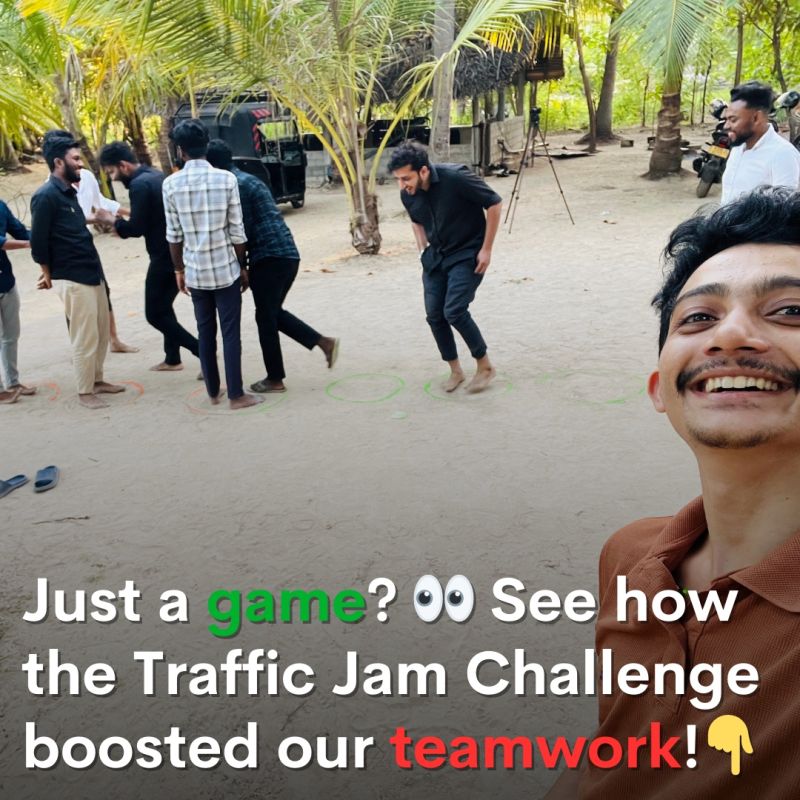
During our most recent annual retreat, we engaged in an insightful yet entertaining activity known as the Traffic Jam game. It may appear to be an effortless game on the outset, but it proved to be a remarkable exercise in collaboration, fearless leadership, and agile teamwork.
As a team exercise, it helped us reflect on our unifying mechanisms as a team beyond the cubicle walls, as well as the myriad of approaches that we together as a team bring forth in solving obstacles that we face at our workplace.
In this blog, I*ll detail the ensemble reaction to the enhancements to teamwork along with the policies on leadership that the game shall usher us into 2025, while dissecting each of the lessons through the lens of the Traffic Jam game.
The Traffic Jam Game: A Quick Overview
This game is an incredible tool aiming to foster perceptions about leadership and teamwork. The setup of this game is as follow:
- Setup: Two lines facing one another, with a gap in the center that separates the two groups.
- Objective: Everyone must try their best to cross to the other side with only bounded room as a “space” to work with. A player may advance to the gap or one step over a participant, they may not skip over two participants, or move backward.
To start, this looks like a straightforward challenge; all you must do is walk and leap over the people blocking your path, correct? The intricacy, however, lies in the synchronization needed to ensure that everyone can get to the other side without any blunders.
The Fun of the Game: A Lively Brainstorming Session
The diversity of concepts provided by the group only added to the excitement of the game. All participants showed up for the activity with their own plans and methods of action, which was somewhat similar to a brainstorming session where everyone pitches in and tries out their ideas.
Initially, there was an overwhelming sense of disorder. People were attempting to put their strategies into practice, but because everyone was working for their own goals, there was little achievement overall. There wasn’t a single decision maker steering this part of the game, so this initial phase lacked organization, which created disorder.
This was when the crucial insight appeared: in the absence of management and structure, even the simplest functions can become overly complex.
Emerging Leadership: The Power of Trust and Direction
While progressing further into the game, we naturally appointed a leader. This was not a title that came with special privileges or any form of official recognition. Someone made the move to step up and decisively lead the group’s actions, taking full command of the next steps.
This leader showed the best strategies, explaining what actions each of them must take towards the goal of the group’s movements, and what the desired outcome was.
In less than twenty minutes, we were all actioning in unison.
It was astonishing to witness the transformation of the game from disorder to order within such a short span of time. The enigma filled group was no longer chasing discrepancies, but rather, effortlessly collaborated toward a singular goal.
This taught us an underlying timeless principle about leadership: leadership influences the dynamic of a group, for better or worse. A well-focused leader requires no shouting or display of domineering presence.
All that is needed is soft-spoken guidance that is projected and confidence that is instilled. Within those twenty minutes, trust was built and we all felt it. Indeed, the game’s motive was far from winning, rather to comprehend the significance of leadership and teamwork
The Importance of Teamwork: Everyone Plays a Role

A central takeaway from the Traffic Jam Game was that every individual has a role to fulfill in order to achieve the team’s goal.
Most of us, for instance, worked on their own self-centric movement, trying to either jump over people or get to the other side in the fastest manner possible. As is the case with several lessons learnt through experiences in life, the game taught us that individual efforts do not lead to success without the contribution of the rest of the team.
In terms of achieving success, cooperation, listening to the leader, and working together towards a shared goal were mandatory for everyone. this is extremely relevant in the context of business. Here at UPBRIGHT, we are well aware of the fact that failure or success depends on the collective effort of all teammates.
For example, the leaders who try to strategically operate and run the business and the individual contributors who complete routine tasks, all add value to the company in their own unique manner.
The game demonstrated that overcoming obstacles requires communication and collaboration working hand in hand. In the absence of teamwork, individual talent loses its value.
Leadership Development: Guiding the Team Through Challenges
The traffic jam game brought forth striking reminders of the leadership challenges involved in shepherding a team. When our assigned leader tried to get the group working, she had to contend with several different types of heads, ways of doing things, and an assortment of understands.
This is similar to the challenges in leadership: a leader has to deal with diverse people who have their own distinct approaches to work.
Having the ability to switch gears constitutes strong leadership. The leader in the game was not too rigid with his plans. He was willing to adapt his methods to suit the team’s achievement towards the best practices as the game dragged on. The ability to bend, respond to changing conditions, and be a catalyst to motivate other people is very important to any leader.
Be it in a business or a team setting, a leader should be able to pull their team through problems and obstacles that stand in their way. The ability to keep every person on task while shifting tactics remains a skill every leader has to cultivate.
How the Game Inspired Us for 2025
As we were playing the Traffic Jam game, we were all thinking about and agreeing to the collective achievement that had to be accomplished. It’s not only reaching from one point to another; it also involves teamwork as well as a common objective.
In terms of UPBRIGHT, this game allowed us to analyze how far as a team we have come and how we can build upon that towards developing a healthier and stronger team.
There is so much work which has already been achieved in 2024, but equally if not more, the work which lies ahead now becomes essential.
As we make the leap into 2025, we are committed to further refining our leadership and collaboration so that every team member can make meaningful strides toward the company’s goals.
Team Growth and Leadership for 2025: Building a Stronger Future Together

The Traffic Jam game was not merely an engaging exercise; it served as an insightful reflection into leadership, working within a group, and agility. While looking ahead to 2025, we remain committed to nurturing an environment where every team member flourishes as well as learning from every experience, challenge, and achievement.
Reflecting on this exercise, the most prominent learning takeaway for me is that every team member should be given the opportunity to be set up for success.
There is not only a single outcome, and there is no individual silver bullet. Striving for a common goal strengthens the entire team. Working together towards a shared objective makes all of us stronger.
Nurturing leadership skills and collaborative practices as well as preparing to hear and value each input from team members will remain central as we focus on planning for 2025.