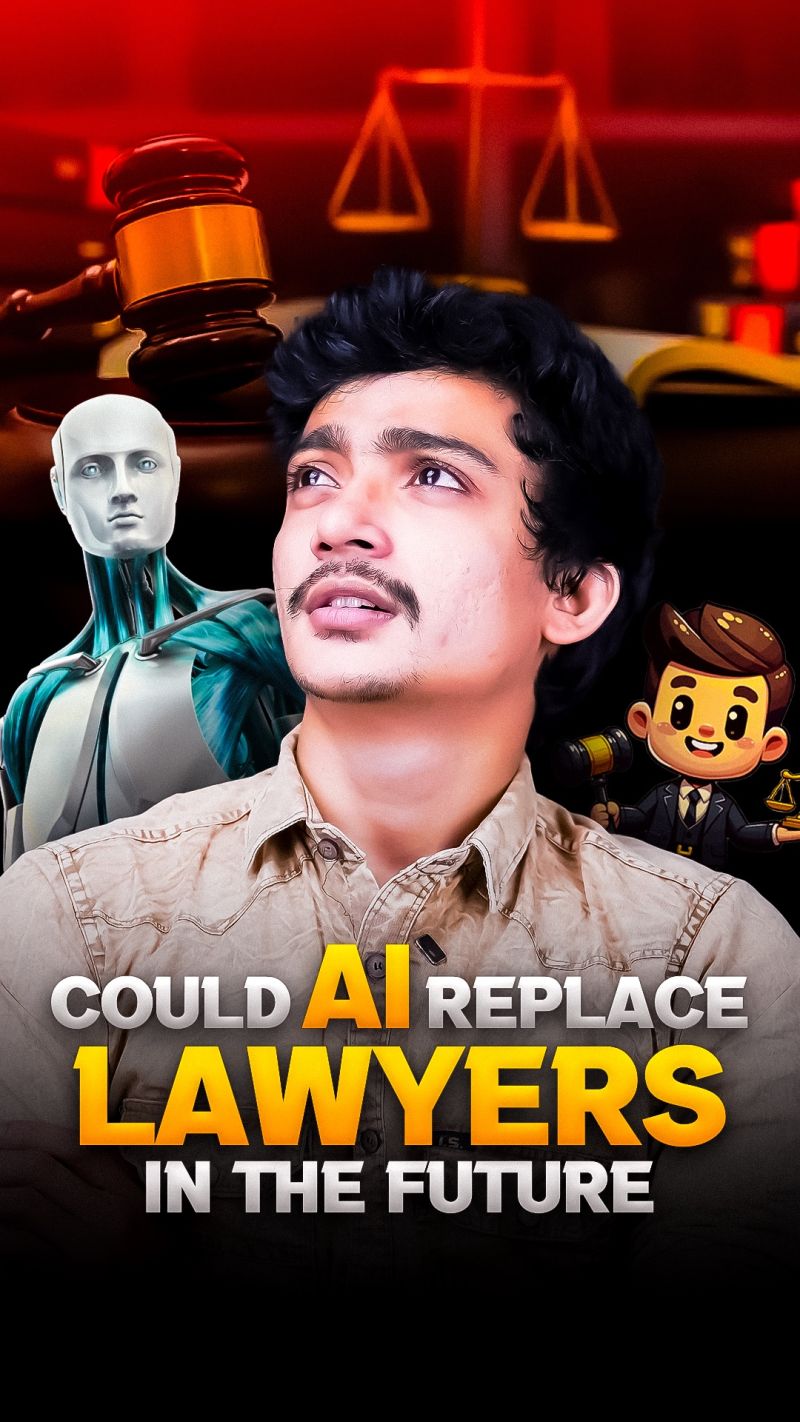
Having transitioned from IT to law, I have been able to witness how artificial intelligence (AI) is impacting many sectors, including the legal industry.
AI has made significant advancements on issues like document assessment, legal research, and drafting contracts. It has drastically reduced the time required to perform tasks from hours to seconds. It is efficient, accurate, and let’s face it—an outstanding aide.
But with all these advancements, the question remains: Could AI completely take over lawyers’ responsibilities?
Would it dominate the legal services industry, with lawyers becoming passive spectators? Although the presence of AI in the legal domain is indisputable, there lies the question of whether it has the capacity to replace the human elements of law—empathy, interpretation, and conviction.
In this blog post, we will discuss what AI can do and not do within the context of the law and how it is more useful as an enhancement rather than a replacement to the work of attorneys. Let’s examine the possibilities and still unresolved issues AI brings to the table in this everchanging world.
1️⃣ AI in the Legal Field: A Powerful Assistant
The Rise of AI in Law
AI’s role in the legal industry has a rich history. Technology, for example, has started to aid law firms in the past ten years. Nowadays, legal practitioners can utilize artificial intelligence for a myriad of procedures including:
- Search within vast databases of legal documents: Legal AI tools can recognize key passages from numerous legal papers, documents, and even books. Identify legal clauses, check for errors flagged by the AIs, cross-check documents for verification, estimate time frames, evaluate place jurisdictions.
- Document review and analysis: Legal AI technologies are extremely useful in case law searches as they automate a majority of tedious clerical processes. Non-disclosure contracts can be non-disclosed by being drawn by machines.
- AI in identifying and reviewing contracts: Indeed, AI technologies can “read” contracts. They analyze business agreements, draft business letters and contracts, make summaries, and report unresolved questions.
- Predictive analytics: AI can assist attorneys in anticipating the potential outcomes of a case using historical information, thus aiding them in formulating more effective strategies for their customers.
These tools are supercharged, increasing a lawyer’s speed, accuracy, and efficiency, all at once. However, they are not replacements. AI may efficiently manage a lawyer’s repetitive data driven tasks, however, devoid of creativity, strategy, or emotional intelligence – areas where law practitioners already have the upper hand.
AI as a Time-Saver, Not a Replacement
AI serves most efficiently as an assistant, handling work at the bottom of the legal profession’s hierarchy, thus, acting as a time efficiency measure. Can law AI strip the essence of attorneys? Let’s explore the components of law that AI solely can’t take over.
2️⃣ The Human Side of Law: Empathy, Persuasion, and Judgment
The Importance of Human Judgment
AI may manage a multitude of legal activities, but there are still basic elements of the law that AI cannot touch as they require human judgment. A legal practice is more than having factual information and data over something; it requires making sense of the information and the law, arguing over different accounts and aspects with a level of wittiness, and understanding emotions.
- Empathy: In family law, for example, an attorney’s empathy is crucial for grasping the needs of clients. Clients going through a divorce or a custody battle, the lawyer’s empathy towards them at an emotional level enables him or her gain the client’s trust. AI systems can give you statistics and data analytics, but they cannot understand the emotional side of things the way people do.
- Persuasion: The majority of legal arguments are struggles on how a certain position is defended, and therefore they require a level of defending that position to a judge or jury especially if your client is a defendant. Naturally, even the defense will present evidence that helps to prove the client’s guilt. A great lawyer is capable of drawing a story while constructing powerful statements such that a blend of emotion and reason is used. AI can provide data but cannot possess the skill of persuasion that lawyers have and this is how lawyers win their cases.
- Legal interpretation: Laws are legal documents and like many documents, they can be open to interpretation. A lawyer in practice always has to fit the particulars of the client’s case into the law through application of his skills, past experience and judgment. Technical research can always be supported by advanced tools like AI, but deriving interpretations of intricate legal concepts demands substantially more than just a legal education. One needs to intimately understand humanity and behavior.
Reading People and Understanding Subtle Intentions
All laws rely heavily upon the concept of people reading; whether that’s garnering the incentives behind witnesses, observing a judge’s minute emotions, or understanding lawyers’ satisfaction. In these respects, machine learning still has a vast amount of progress to make. Machines may take a stab at objective facets like evaluating factual information, but everything dealing with sentiments is simply beyond their comfort zone.
Using human knowledge and intuition, an individual lawyer should be able to evaluate the dependability of witnesses in criminal matters or even the emotional health of the blamed. These elements are exclusively born out of imagination, something machines lack entirely.
3️⃣ AI + Lawyers: A Powerful Partnership
So, can AI replace lawyers? The answer is clear: No, AI can’t replace lawyers. But AI doesn’t have to replace lawyers as well. On the contrary, AI can be a wonderful asset that enables lawyers to work smarter and accomplish more.
Picture a situation in which lawyers utilize AI to carry out repetitive tasks such as legal research, document drafting, and even contracts analyses. At the same time, the lawyer manages the strategy, client correspondence, and legal arguments presentation. The blend of AI speed and human judgment can achieve a remarkable increase in productivity for both the lawyer and the client.
- AI taking care of the grunt work: When the repetitive tasks are taken care of by AI, lawyers can spend their time on higher order functions, including thinking, negotiating, and making decisions.
- Greatly improved client satisfaction: During times that are not spent attending to personal clients, lawyers dealt with relationships. This made service efficiency stronger and achieved quicker resolution cycles for a number of processes.
AI in Legal Practice: The Future of the Industry
It’s not the case that AIs will take over the jobs of lawyers; Rather the emphasis will be on AI adopting technical works while lawyers focus on matters requiring human touch to empathy, creativity, and strategic thought.
Consider the example of a lawyer who has an AI assistant at their disposal. With this assistant, the lawyer is capable of analyzing case law, drafting important documents, and even computing precise predictions for case outcomes all within a very short period of time. As a result, the lawyer is able to shift his focus to crucial lines of work such as creative thinking, effective communication with clients, and optimizing the presentation of the case during courtroom procedures
The Human Touch in a Tech-Driven World
AI is undoubtedly powerful as well as fast, however, it cannot completely take over the human element. In law AI, it is not simply a matter of information, but rather a matter of analysis, logic, and experience. Lawyers add the emotional side of justice. Sure, AI can help with the efficiency of tasks, but it is the human element that is essential for the effectiveness in law.
4️⃣ Moral of the Story: AI Can Assist, But Lawyers Bring the Heart to Justice
The legal industry is experiencing unprecedented transformation thanks to AI technology; however, AI will not be taking over legal practice anytime soon. While AI can optimize productivity and handle mindless tasks, it will never be able to mimic the human traits integral to the profession – compassion, decisive judgment, and influence.
Ultimately, law is not about robots and lawyers. It is about enhancing lawyers’ capabilities and providing them with help to do their best work. AI technology has the potential to assist, but the heart, wisdom, and experience needed individual hands will always be irreplaceable.
The Future of Law is a Blend of AI and Human Expertise
From a broader perspective, every work aspect is rapidly changing with the assistance of AI technologies, including the legal sector.
The incoming changes set AI up for a more prominent position in the industry, but humans will always be essential. The division of labor where AI handles the technical aspects and attorneys apply compassion, creativity, and judgment is where true progress lies.
The legal profession’s traditional duties will change with the advancement of AI technologies, but they will not be eliminated.
AI will help lawyers accomplish their tasks at a higher level and focus on the complex parts that need their unparalleled expertise. AI and lawyers will coexist and together.